
Introduction
Can you imagine yourself on a hot, sunny beach in the middle of summer wearing a fur coat, gloves, jeans, wool socks, and boots? I would be miserable, sweating continuously, while chugging water to keep hydrated. Typically people wear little to nothing, for example shorts or a swimsuit, when living on the beach.

Mammals in general, not just humans, tend to slim down in hot environments and bulk up in cold environments. In the Tundra, mammals have more mass and are furrier than comparable species in the tropics, because skin exposure in frigid environments means more internal energy is used to regulate body temperature (tundraaminals.net). The process of regulating body temperature is known as thermoregulation. Thermoregulation is a process that keeps your internal temperature at equilibrium, known as homeostasis (healthline.com, 2016). There are two types of organisms, in regards to thermoregulation, ectothermic and endothermic (pediaa.com, 2018). Ectothermic organisms, i.e. reptiles and amphibians, regulate their internal temperature by adjusting to their environmental temperature. Ectotherms, “cold-blooded animals”, adjust to their environment’s temperature in a number of ways like taking a plunge into a pool of water when internal temperature becomes too hot and basking in the sun on warm, dark rocks when internal temperature is too cold. Endothermic organisms, i.e. mammals and birds, are refereed to as “warm-blooded animals”, regardless of the environment’s temperature endotherms stay at homeostasis thanks to key processes: metabolism and shivering (pediaa.com, 2018). Endotherms eat more sugars and fats that their bodies break down and generate into energy and heat (pediaa.com, 2018). In the recent lab experiment Will Foushee and I tested the difference between the heating and cooling rates of small and large body endotherms. We best observed this data with scatter plots, because we have a dependent variable, temperature (degrees Celsius), and an independent variable, time (minutes). By observing the comparable data, 60 measurements of temperature over time in minutes, we can test our hypothesis: If an endotherm has a large body and is placed in an environment with a constant high temperature, then its internal body temperature will heat up faster and cool down slower than an endotherm with a smaller body size. This hypothesis is supported by J. P. Whiteman and colleagues with their report, “Summer declines in activity and body temperature offer polar bears limited energy savings”. In the report it is mentioned that because of polar bears’ thick coat and large volume the bears tend to be less active in the summer in attempts to preventing overheating, because they do not dissipate heat well (J.P. Whiteman, 2015).
Methods and Materials
Will Foushee and I used the following materials to conduct the experiment; a heat lamp, aluminum foil, cotton balls, a thermometer ( in degrees Celsius), and a timer (smartphone). We started the experiment by creating a 10 cm sided cube out of aluminum foil. We placed this cube under the heat lamp approximately 1.5 inches away from the bulb. We placed the tip of the thermometer within the cube and recorded the internal temperature every minute until the temperature plateaued, stopped rising. Once a maximum temperature was reached we turned off the heat lamp and removed it from the cube; in order to remove any remaining heat on the cube. We continued to record the internal temperature every minute following until we reached our initial temperature from the start of the experiment. This data we set as our control; as seen in figure 1 in the Results section. For our small body endothermic organism we created a similarly sized aluminum cube stuffed with cotton balls, cotton balls acting as insulation; a typical trait of endotherms (Thermoregulation Lab). We conducted the same experiment as before but instead calculated the warming of the internal temperature for 15 minutes and the cooling for 15 minutes. For our large bodied endotherm we did the exact same thing as the small bodied endotherm but our aluminum cube was about double the size as the small bodied cube, and also filled with cotton balls for insulation.
Results
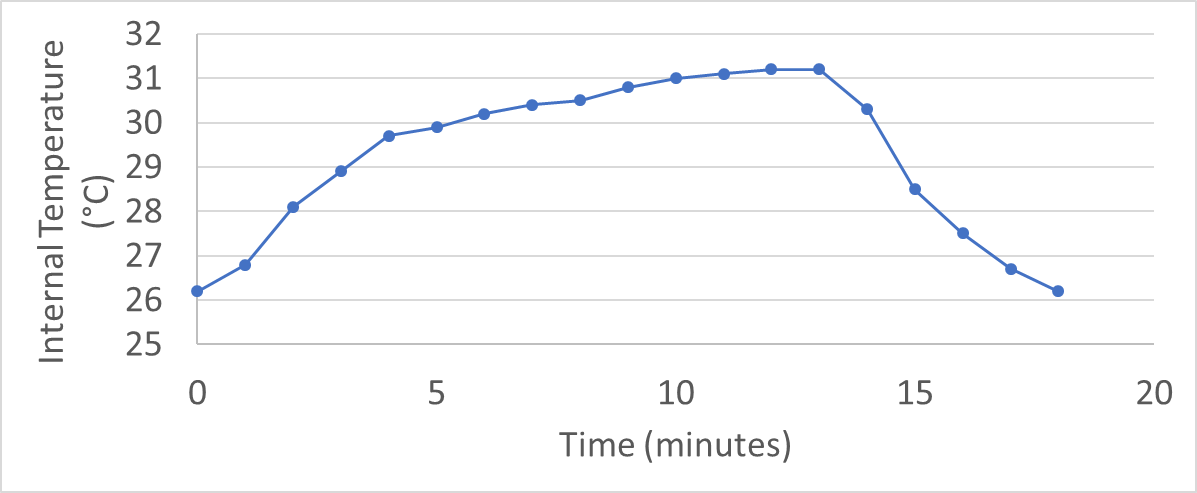
Observations: quick initial warming rate that slows down significantly around the 4 minute mark, a maximum temperature at about 31 degrees Celsius, and a rapid cooling rate that is significantly greater than the warming rate.

Observations: both curves are similar, but the large body endotherm’s warming rate is greater starting around the 2 minute mark, and the small body endotherm’s cooling is greater from the 17 minute mark to the 21 minute mark.
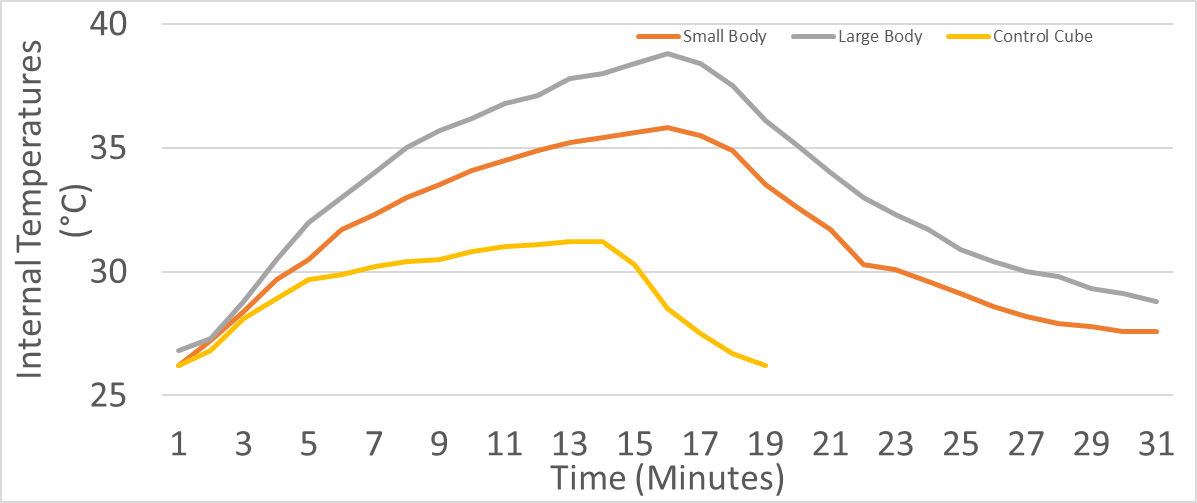
Observation: Both endotherms’ heating rates are greater than the control, but the control has a much greater cooling rate than both endotherms.
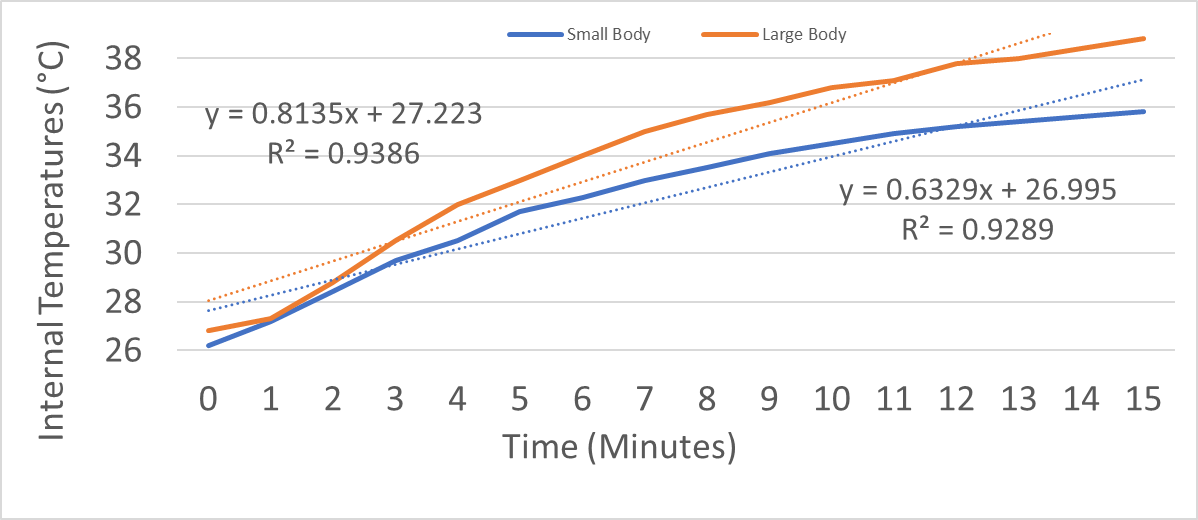
Observations: The larger bodied endotherm has a greater slope than the smaller bodied endotherm; The larger endotherm has a faster warming rate.

Observation: The larger endotherm has a greater slope out of the two negatives; the larger endotherm has a faster cool down rate.
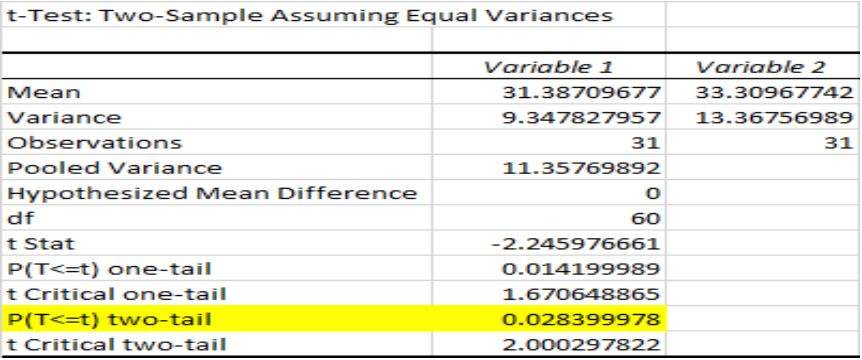
Observation: P value = 0.028399978 < 0.05; since p-value is less than 0.05 there is a statistically significant difference between the means of the two populations; this shows small and larger bodied endotherms have different cooling and warming rates; concluding that size does matter.
Discussion
In this experiment we attempted to test the relation of cooling and warming rates in exothermic organisms. We choose body size as our study factor. This factor is key to understanding the effects climate change and global warming has on endothermic organisms of different body sizes. In J.P. Whiteman and colleagues’ report “Summer declines in activity and body temperature offer polar bears limited energy savings” it is necessary to understand how large endothermic polar bears cool down in warming summers. We designed the experiment to test different body sizes of endotherms by insulating both “organisms” causing them to auto-regulate internal temperatures and differing the sizes of the organisms’ surface area and volume. We unfortunately suffered from a time constraint preventing us from acquiring more measurements. The results were surprising because we hypothesized that the larger endotherm would have greater warming rates, as observed, and slower cooling rates, which was contrary of our results. In figure 5 of the results it is obvious that the larger endotherm had a greater negative slope than the small bodied endotherm; meaning the larger bodied endotherm cooled down faster. I am quite puzzled by this result. I believe that because the larger endotherm had a hotter temperature maximum than the smaller endotherm than the loss of heat was greater because the difference between the environment and the internal temperature of the larger body was greater than the smaller body.
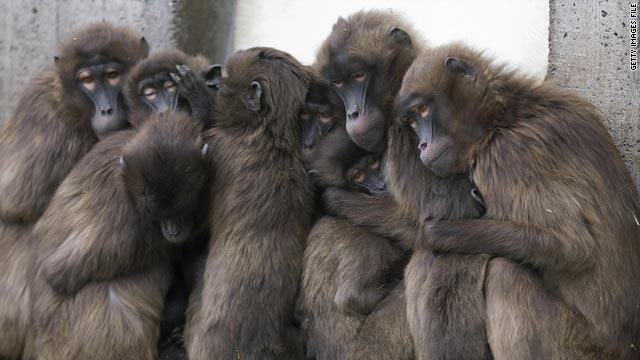
I can compare this information with the University of Lincoln’s “Huddling for survival: monkeys with more social partners can winter better” report by comparing small bodied endotherms to less sociable, lonely monkeys and large bodied endotherms to more sociable, large groups on monkeys. In our results we discovered that large endotherms warm up a lot faster, so larger groups of monkeys will warm up faster which is key to their survival. Also I can compare the University of Sydney’s “Monkeys eat fats and carbs to keep warm” report with my own because endotherms have faster metabolisms than ectotherms so it is no surprise that the monkey’s in the report are eating more fats during the winter than the spring so they can maintain homeostasis (pediaa.com, 2018). The winter in the report is comparable to my cooling times in the results section that is when the heating lamp was turned off and winter is known to have fewer hours of sunlight, the sunlight being compared to the heating lamp. So according to my data, hypothetically, larger endotherms would need to eat even more fats to counter their faster rate of heat loss.

Conclusion
In conclusion larger bodied endotherms have significantly greater warming rates of internal temperature than smaller bodied endotherms and similar but, a bit faster, cooling rates of internal temperature over time than smaller bodied endotherms.
References
Whiteman, J. P., Harlow, H. J., Durner, G. M., Anderson-Sprecher, R., Albeke, S. E., Regehr, E. V., . . . Ben-David, M. (2015). Summer declines in activity and body temperature offer polar bears limited energy savings. Science,349(6245), 295-298. doi:10.1126/science.aaa8623
Difference Between Ectotherms and Endotherms | Definition, Characteristics, Examples, Similarities and Differences. (2018, February 02). Retrieved February 9, 2019, from http://pediaa.com/difference-between-ectotherms-and-endotherms/
Tundra Animals. (n.d.). Retrieved February 9, 2019, from https://www.tundraanimals.net/
Thermoregulation | Definition and Patient Education. (n.d.). Retrieved February 9, 2019, from https://www.healthline.com/health/thermoregulation
Huddling for survival: Monkeys with more social partners can winter better. (2018, May 30). Retrieved February 9, 2019, from https://www.sciencedaily.com/releases/2018/05/180530113118.htm
Monkeys eat fats and carbs to keep warm. (2018, June 08). Retrieved February 9, 2019, from https://www.sciencedaily.com/releases/2018/06/180608093646.htm
 Of The Forest