
Introduction
This week’s blog is a personal reflection on the importance of science communication. I will be analyzing: the blog, “Effective Communication, Better Science” by Monica I. Feliu-Mojer, The YouTube video, “What is Science Communication? – The EU Guide to Science Communication” by Rhonda Smith and Alexandra Ruete, “Alan Alda: Science Communication” by Alan Alda, and “Your Wild Life” blog. Following is each of my personal reflections and their importance to me.
Analysis of “Effective Communication, Better Science”
Science communication is defined broadly by Monica I. Feliu-Mojer as, “Any activity that involves one person transmitting science-related information to another (Feliu-Mojer, 2015).” Monica goes on to give a broad range of examples,”from peer-reviewed articles to tweets (Feliu-Mojer, 2015).” According to this definition I have inadvertently used science communication for almost a decade. Even though that decade was not filled with peer-review articles and journals, it was dotted with many Facebook posts about things I learned in school and other interesting scientific information found online. For the past year I have been required to write official lab reports that followed IMRAD (Introduction, Materials/ Methods, Results, And Discussion) formatting. I find it funny that my experience with scientific communication is a metaphorical roller-coaster. It started with casual Facebook posts, followed by official, instructor-analyzed lab reports, and now blogging, which is formal enough to be persuasive and informative, but also informal in strive to reach a larger audience. Reaching a broad, interdisciplinary audience is key to proposing solutions, spreading ideas, and bringing attention to scientific problems. I understand that whoever decides who or what receives funding does not always have the time to read every word of the materials and methods section of a report/ article, so a well-thought, relatable summery or abstract are key pieces to scientific communication. But according to a pier-reviewed article by
Thomas Dietz in the journal PNAS (Proceedings of the National Academy of Sciences of the United States of America) “If Science communication is intended to inform decisions, it must be competent with regard to both facts and values”(Dietz, Thomas, 2013). As mentioned in Monica’s blog, Einstein once said, “If you can’t explain it simply, you don’t understand it well enough,”(Feliu-Mojer, 2015). The ability to simplify complex information is key when trying to receive public support. This is why scientific communication is a growing aspect of science. As a student learning effective scientific communication can help reach out to organizations for scholarships, help persuade companies to consider you for internships and jobs, and help persuade benefactors for funding for scientific research.
Analysis of “What is Science Communication? – The EU Guide to Science Communication”
According to the short video Rhonda Smith states that, “Science communication is about reaching to non-experts,”(Smith, R., Ruete, A., 2016). This definition of science communication is a more specific definition in comparison to Monica I. Feliu-Mojer’s definition of, “Any activity that involves one person transmitting science-related information to another (Feliu-Mojer, 2015).” Rhonda Smith’s proposed definition applies to only an audience of people outside your specific field of expertise. For example, tax payers who inadvertently fund government funded research (Smith, R., Ruete, A., 2016). This specific example is important because it is government funded researchers’ obligation to inform tax payers where and how their money is being proactively used in their research (Smith, R., Ruete, A., 2016). It is important that scientist use science communication, because if tax payers do not know what it is that they are doing and do not feel a connection to the research they may opt to stop the funding (Smith, R., Ruete, A., 2016). Scientific dissemination on the other hand is directed to your peers in your scientific field (Smith, R., Ruete, A., 2016). For example, dissemination is used to communicate research with your peers in sight of publication in a scientific journal (Smith, R., Ruete, A., 2016). In my opinion science communication is more important than scientific dissemination, because funding is more valuable than ethos. Possibly, without funding there would no ethos.
Analysis of “Alan Alda: Science Communication”
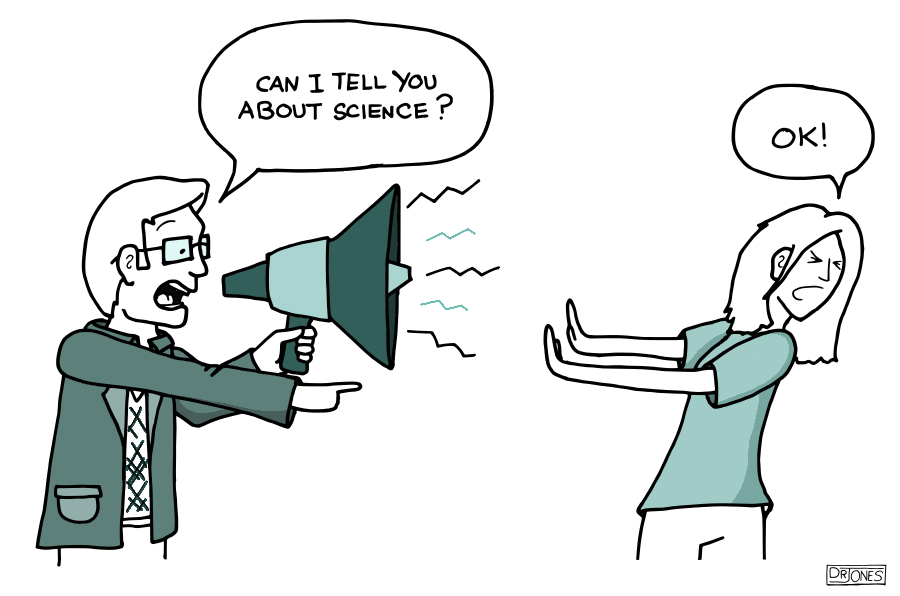
Allen Alda goes on record stating that, “Everyone is too ignorant about science. That is what science is about: Science is about satisfying the ignorance we all naturally possess” (Alda, Allen, 2016). I think Alda is trying to convey that the role of scientists is to guide the general public towards scientific thinking, by pointing out problems and identifying solutions and theories, and that the general public have the role of identifying what sciences are necessary for the current public demand and interest. I identify that, without the right message to spark public interest, truly important research can be unappreciated and be unfunded by the general public. I will try to reflect the aims of science communication by broadening my results to appeal to a larger audience and use relatable scenarios to create a connection to the research.

Analysis of “Your Wild Life” blog
I believe this blog is organized well and utilizes a descriptive photo of each post to help navigate efficiently. I find it hard to navigate the blog, because I can not understand the context of each post by just the first sentence or two of the post. A brief abstract along with the title will help readers find content relatable to their interest and inquiries. Also, the author of the post and the date it was published only appear in the blog, not in the individual posts. After searching through the posts two stood out to me: What to Do About the Ants in Your Kitchen and Ten Things Graduate Students Should Study (Never Out of Season Edition) both by Rob Dunn. These two stood out to me because they are relatable to me. I have a kitchen and I am a student. I feel that the Ten Things Graduate Students Should Study is very personable and organized well. It did not overload me with information and presented well-organized subjects to study individually. The post What To Do About the Ants in Your Kitchen drew me in with a relatable, personal experience. It also was the first post that I read to utilize graphs. I will strive to use such luring stories and informative graphs in my future blogs to help attract and keep the intention of my audience.
References
Feliu-Mojer, Monica I. (2015, February 24) “Effective Communication, Better Science” [Blog post]. Retrieved from https://s3.us-east-1.amazonaws.com/blackboard.learn.xythos.prod/59442bc14e926/10163?response-content-disposition=inline%3B%20filename%2A%3DUTF-8%27%27SCIENCE%2520COMMUNICATION%2520Effective%2520communication%2520better%2520science.pdf&response-content-type=application%2Fpdf&X-Amz-Algorithm=AWS4-HMAC-SHA256&X-Amz-Date=20190121T143100Z&X-Amz-SignedHeaders=host&X-Amz-Expires=21600&X-Amz-Credential=AKIAIL7WQYDOOHAZJGWQ%2F20190121%2Fus-east-1%2Fs3%2Faws4_request&X-Amz-Signature=35535e8960634a09c0809e59083a9bf13b01db436f6b969ea82559f61accb0e0
Smith, R., Ruete, A., (2016) “What is Science Communication? – The EU Guide to Science Communication” [Web video]. Retrieved from https://www.youtube.com/watch?time_continue=138&v=4E8rXg3Nv7U
Alda, Allen, (2016, May 5th) “Alan Alda: Science Communication” [Web video]. Retrieved from https://www.youtube.com/watch?time_continue=346&v=S0m4iDiTeto
Dunn, Rob (2017, August 8th) “What to Do About the Ants in Your Kitchen” [blog post]. Retieved from http://yourwildlife.org/2017/08/what-to-do-about-the-ants-in-your-kitchen/
Dunn, Rob (2017, March 6th) “Ten Things Graduate Students Should Study (Never Out of Season Edition)” [blog post]. Retrieved from http://yourwildlife.org/2017/03/ten-things-graduate-students-should-study-never-out-of-season-edition/
Dietz, Thomas (2013, August 20th) “Bringing values and deliberation to science communication” Proceedings of the National Academy of Sciences of the United States of America 110 (Supplement 3) 14081-14087. Accessed January 20, 2018. doi: 10.1073/1212740110.

 Of The Forest
